Peace
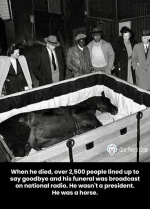
When he died, over 2,500 people lined up to say goodbye and his funeral was broadcast on national radio. He wasn't a president. He was a horse.
November 1, 1947. On a quiet Kentucky farm, Man o' War the fiery chestnut Thoroughbred who redefined greatness breathed his last at thirty years old.
For three decades, his name had been synonymous with power, speed, and untamed excellence. He won 20 of 21 races, shattered every record, and captured the imagination of a nation still recovering from war and economic hardship.
When word spread that Man o' War had died, something extraordinary happened.
Americans mourned him like they'd lost a national hero—because they had.
His body was carefully embalmed and placed in a solid oak coffin lined with his signature red-and-yellow racing silks—the colors that had blazed across finish lines two decades earlier. He was laid in state at Faraway Farm in Kentucky, where he'd lived out his retirement as one of the most celebrated sires in racing history.
Over 2,500 people came to pay their respects. They stood in line for hours, waiting to see him one last time. Radio stations across the country broadcast his funeral. Newspapers ran front-page obituaries. People wept openly.
For a horse.
But Man o' War wasn't just any horse.
He was the horse that made America believe in greatness again. Born in 1917, during World War I, he began racing in 1919—a time when the country desperately needed something to believe in, something beautiful and powerful and unstoppable.
Man o' War gave them exactly that.
His racing career lasted just two years, but in that time he became legend. He won by margins so large that other horses looked like they were standing still. He broke track records at nearly every course he ran. His only loss came in 1919 to a horse named "Upset"—and that race became so famous that it gave the English language a new meaning for the word "upset."
After that single defeat, Man o' War never lost again. He retired in 1920 with 20 wins in 21 starts, earnings of $249,465 (worth over $3 million today), and a reputation as perhaps the greatest racehorse ever to run.
But his impact went beyond the track.
During his retirement at Faraway Farm, Man o' War became a tourist attraction. People traveled from all over the country just to see him. They brought their children to meet the legend. He received visitors daily, and his owner Samuel Riddle made him available to the public because he understood: Man o' War belonged to America now.
The horse received birthday cards and letters. People sent him sugar cubes and carrots. When he sired successful offspring, newspapers reported on his "children" like they were royalty.
He appeared in newsreels and on magazine covers. His likeness was used to sell everything from cigarettes to cereal. He was, quite literally, the most famous animal in America—long before television made such fame common.
When he died, the grief was genuine and widespread. This wasn't just about horse racing. Man o' War represented something deeper: excellence pursued with grace, power tempered with beauty, greatness that inspired rather than intimidated.
He was buried at Faraway Farm with full honors. His gravesite became a pilgrimage destination. In 1977, when Faraway Farm was sold, the Kentucky Horse Park moved his remains to their grounds, where his grave—marked by a life-size bronze statue—still receives visitors daily.
His funeral in 1947 drew more mourners than many human celebrities of the era. Radio stations interrupted programming to cover it. Newspapers devoted entire sections to his life and legacy.
Because Man o' War wasn't just a racehorse. He was courage made flesh. He was beauty in motion. He was untamed spirit that could be harnessed but never diminished.
In an era before television, before social media, before instant celebrity, Man o' War captured the nation's heart through pure excellence. He ran with such power and grace that even people who'd never attended a horse race knew his name.
Today, over 75 years after his death, Man o' War is still consistently ranked as one of the greatest racehorses of all time—often in the top three, competing for recognition with Secretariat and Seabiscuit.
But the horses that came after him all ran in his shadow. They all chased records he set. They all inherited a sport he transformed from pastime to national obsession.
When Man o' War died on November 1, 1947, America didn't just lose a horse. They lost a symbol of an era—a reminder that greatness, once witnessed, becomes immortal.
Over 2,500 people came to say goodbye to an animal they'd never ridden, never touched, but had loved from a distance simply for being extraordinary.
His hooves fell silent that November day. But their echo still resonates through every racetrack, every Derby, every moment when a horse rounds the final turn with impossible speed and crowds rise to their feet in wonder.
Man o' War: March 29, 1917 – November 1, 1947.
The horse so great that when he died, the nation mourned. The legend so powerful that his name still means greatness itself.
He wasn't just a champion. He was the standard by which all others are measured.
And when America buried him with honors fit for a hero, it was because that's exactly what he was.